
Friday, May 1
Connecting the Carolinas — Dear Maribella at Poplar Grove; Claremont: America's War in the Americas, Part II; Coastal Gardening Festival and Founding Mother's Day postponed; Wilmington Derby Party

Dear MariBella and the Pigkickers at Poplar Grove
By CDD Staff
Come see Dear MariBella and the Pigkickers live at The Listening Barn at Poplar Grove Plantation just outside Wilmington. Enjoy some foot-stomping good times. It goes from 5:30-9:30 p.m.
The Listening Barn hosts a variety of American music; whether it is bluegrass, jazz, or country, one thing is for sure, folk music is what the barn is all about. The Listening Barn is a place where you can gather to relax and enjoy good music or get up and dance. At The Listening Barn, you are sure to enjoy an evening where you can unplug and reconnect.
Get your tickets by clicking here: https://www.eventbrite.com/e/dear-maribella-and-the-pigkickers-tickets-1983557418635?aff=ebdssbdestsearch.
You may find Poplar Grove Plantation at 10200 U.S. 17 in Wilmington.
America’s war in the Americas, Part II
Because of the Trump administration, the United States finally has a strategy.
Continued from April 30 …
What comes next will have to be seen to be fully understood. In this new strategic territory, we have mostly the precedents of the past year and the first Trump term to guide us. What seems to be emerging is a model of offshore presence (mostly naval) that is sustained in the Caribbean basin by a reconstituted network of American facilities.
At the successful conclusion of the Panama invasion in early 1990, the U.S. possessed a constellation of bases throughout the region for the provision of regional security, its own security, and the defense of the Panama Canal. Within a decade, the U.S. had surrendered nearly all of it, and by the beginning of the second Trump term, even local-regime partnerships across the region had mostly collapsed. Narco-regime leaders, including Bolivia’s Evo Morales and Mexico’s Andrés Manuel López Obrador, for example, had effectively ended cooperation with American law enforcement, and a partnership with the American military was unthinkable.
That position has been clawed back in a hurry during the first year of the second Trump administration, thanks in no small part to a remarkable operational partnership between the secretaries of state and war. The focus has been on the Caribbean basin, including the littoral of the old Gran Colombia—what Secretary of War Pete Hegseth has termed “Greater North America.” Now we will see how much further the U.S. will extend its footprint.
While an enduring presence in that geographic sphere is likely, what is not likely, and certainly not as desirable, is a commitment of permanent forces in the immense South American interior. Raids such as those in Ecuador are for political signaling as much as military efficacy. U.S. troops will no doubt be sent again elsewhere in the vast, ungoverned spaces that characterize the continent. The Colombian Amazon, the Peruvian Andes, the Bolivian Altiplano and the Paraguayan Gran Chaco are all candidates for action. To the extent that the new model is viable long-term, it enables partner regimes to consolidate internal stability and facilitates the improvement and operations of their own armed forces.
The alternatives of disengagement and militarization, proponents of the plan would argue, have been tried, and they have failed. For all the strategic and operational cautions at hand, the main point should not be missed: Those proponents are probably correct.
Tres problemas
Missing at Doral were three of the major states and regimes at the heart of the narco-terror problem in the Western Hemisphere: Mexico, Colombia and Cuba.
The Mexican regime, helmed by a political party in MORENA with its own dubious past of cartel partnerships, is struggling to stay out of American sights as a target for action: The recent killing of the Jalisciense cartel boss “El Mencho” can be interpreted as an effort toward this end, an offering to the Americans in lieu of the narco-politicos the Americans have demanded. The public announcement of U.S. aid in the operation is evidence for it, tying the Americans to the Mexicans’ preferred approach.
Yet that regime now confronts the reality that the Americans are setting up a hemispheric superstructure in pursuit of the narco-terrorists, and — not least because President Trump’s personal prestige is committed to it — they will expect Mexico to join it sooner rather than later. This is an insoluble problem for the Mexican regime absent the strategic choices it has been unwilling to make. Having chosen to harbor cartel-aligned politicians within its leadership for years, it deserves no sympathy for the wrenching decisions ahead.
For the Colombians, burdened with the far-left ex-terrorist President Gustavo Petro, but with legislative elections this month and a presidential election in May, it is a waiting game. Colombia is arguably the keystone nation for American strategy in South America. Whether it aligns with or against the U.S.’s efforts is consequential in ways that the choices of other nations are not.
In the opening of the American Civil War in 1861, Abraham Lincoln wrote of Kentucky’s indispensable geography that “to lose Kentucky is nearly the same as to lose the whole game.” Colombia is now surpassingly important for similar reasons. American strategy and operations alike await the choices of that nation’s electorate. But given the influence that many of the narco-cartels have on that electorate in their quasi-sovereign control of Colombia’s rural areas, we may ask whether American action may make itself felt there before the ballots are cast.
Cuba, finally, has been pronounced the next domino to fall to American grand strategy, not just in the hemisphere but globally. As of this writing, there are reports that the Cuban regime is close to agreeing to a sort of concordat with the U.S. in a bid to save itself, much as Delcy Rodríguez and her clique did in Venezuela. The Cuban dictator Miguel Díaz-Canel has publicly announced the existence of negotiations, and there is at least one confirmed report of a crowd of angry Cubans sacking a local headquarters of the Communist Party. There are also reports that the U.S. is planning direct military intervention on the island.
When and if events there culminate — an epochal triumph for the U.S. if it does — that regime too will be folded into the greater ACCC, either de facto or de jure. Cuba will, for a time at least, revert to what it was in the generation after its first independence: a strategic ward of the U.S., this time with no need for a Platt Amendment to validate American stewardship. Given the Cuban Communist regime’s long history of support for, and creation of, the very narco-terror networks America now confronts, the trove of intelligence — not just on those cartels, but on their state partners — will be prodigious and revelatory.
The whole game hinges upon the credibility and presence of American hard power. In January it was real and compelling because it was visibly present. In March, the USS Gerald R. Ford, the sole capital vessel of the Caracas raid, was on the other side of the world, pursuing an entirely different war — although not a wholly unconnected one, as the Iranians established their terror networks in Latin America decades ago and have enhanced them since. That conflict draws in ever-growing echelons of American forces from all corners of the world. SOUTHCOM is not immune to the widening gyre. Nevertheless, it is notable that when the Ford left, it was replaced by the venerable USS Nimitz, whose planned 2026 decommissioning is now delayed to 2027 for this strategic mission.
One may ask whether and when the regimes in Havana and Mexico City might conclude that the American threat, real as it is, is also impermanent. To this end, the Congress ought to urgently consider making the Trump administration’s strategic and deployment innovations in the Western Hemisphere permanent by legislation. The alternative is a swift reversal by a next administration less confident in American power abroad.
America has a strategy in the Western Hemisphere, and the Trump administration is taking the U.S. and its armed forces places it has never been, for reasons it has never confronted in quite this way. As policy, it is eminently defensible. The verdict of history will refrain from making a pronouncement until the age to come. What we can say, though, is this: It is happening, and it is popular. In an American right otherwise fractious over matters of war and peace, from NATO to Ukraine to Taiwan to Iran, the desirability of American hard power in the Western Hemisphere is the one point of unity. It means shots fired, troops deployed and new strategic commitments, but this — not yesterday’s false peace — is what they voted for.
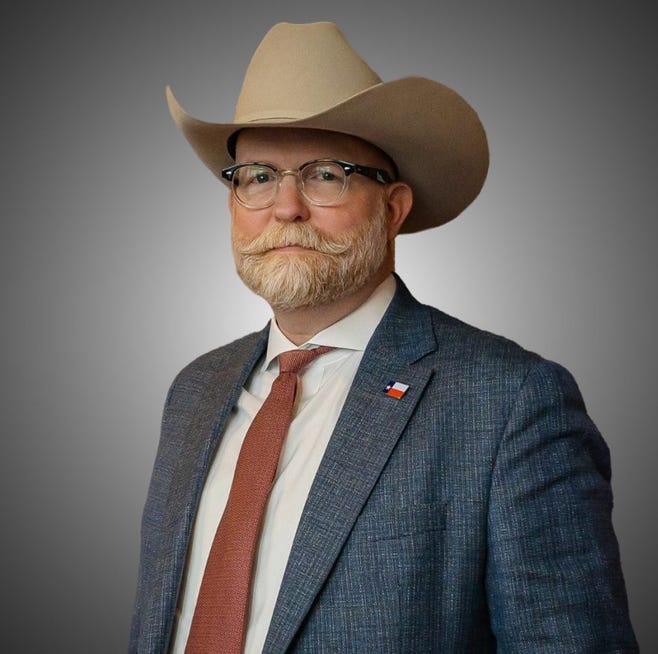
Joshua Treviño is the senior fellow at the Western Hemisphere Initiative and senior advisor to the president at the America First Policy Institute. He is also the chief transformation officer at the Texas Public Policy Foundation.
This article originally appeared in the Claremont Institute’s The American Mind.
Coastal Gardening Festival postponed until Sunday

By CDD Staff
Due to a rainy/stormy/windy forecast for Saturday, the Coastal Gardening Festival will be held on Sunday, May 3 at the Baum Center from 9-2. More than 2,300 plants will be on sale.
Expect a day of plant sales, bake sale, vendors, education, children’s activities and fun. The Baum Center’s master gardeners have raised their plans on the Outer Banks and are more hopeful to thrive and survive in our coastal area. There will be many native plants as well as houseplants, vegetables, shrubs, trees and more.
Grab your wagon, friends, family, kids, dogs and reusable bags and come out for the Coastal Gardening Festival; you won’t go home empty handed.
All the action will be at 300 Mustian Street in Kill Devil Hills.
Charleston’s ArtWalk this Friday
By CDD Staff
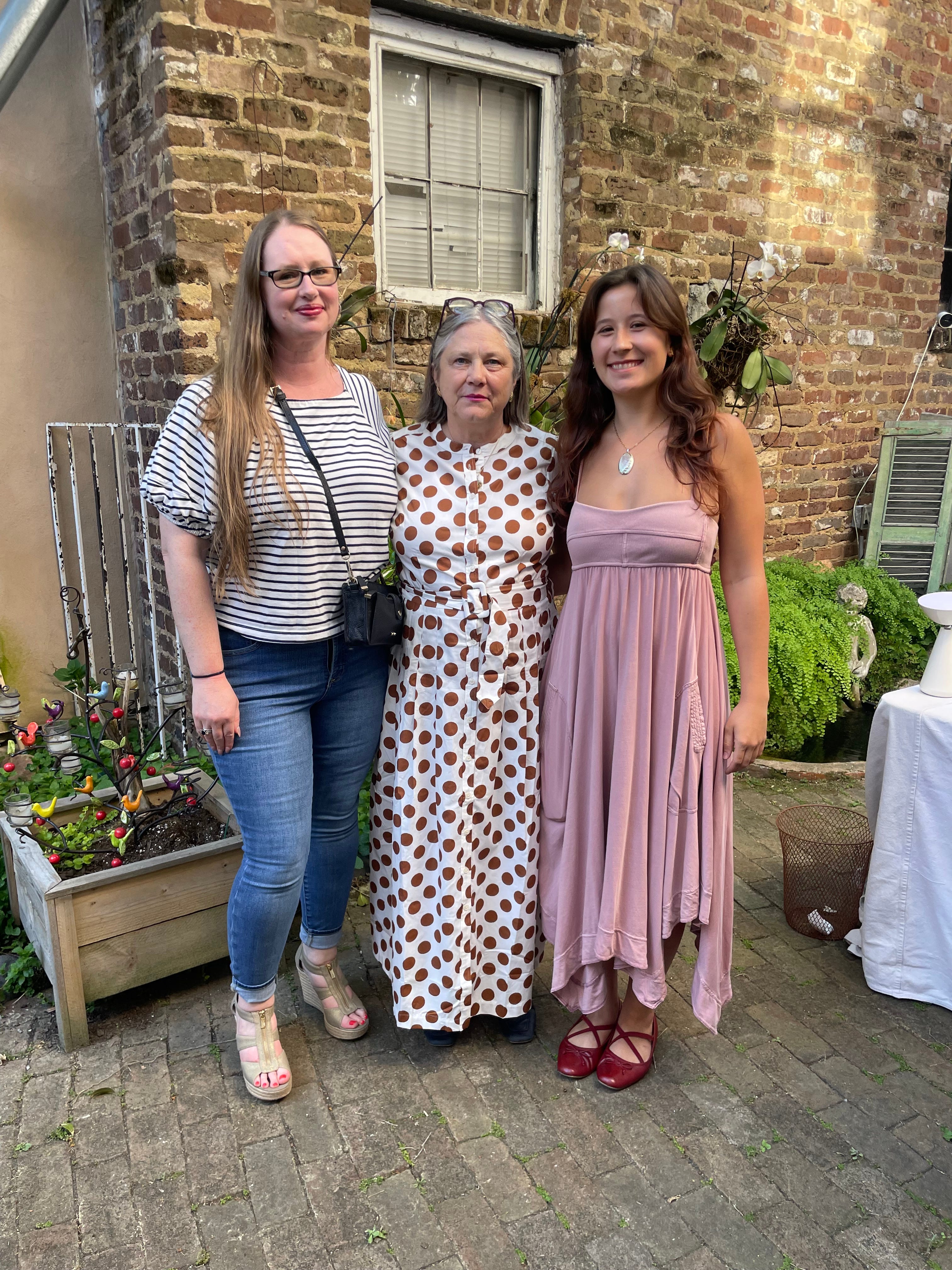
The Charleston Gallery Association invites one and all to their monthly ArtWalk from 5-8 p.m. Discover the vibrant art scene of Charleston and indulge in the delightful festivities of the First Friday ArtWalk. Take a stroll downtown through some of the liveliest neighborhoods enjoying this vibrant community event.
Start wherever you’d like and stroll through downtown Charleston enjoying the charms of the city alongside incredible artwork. Maps may be found at participating galleries as well as on the CGA’s website at https://www.charlestongalleryassociation.com/map.

Unlocking cultural treasure, Part XXXVI
Yenta יענטא
By Susan Weintrob
For most of its lifespan, Yenta יענטא. has been a Yiddish female name, derived from Yentel, which comes from the French word “gentille” (nice or pleasant).
In common American Jewish culture, heavily influenced by the Yiddish theater and media of the 20th century, “Yenta” has come to refer to a talkative and nosy woman. Yenta’s loquacious, overbearing, nosy personality is apparently a credit to Yente Telebende, a fictional character who was born in New York’s Yiddish newspapers and soon created an Yiddish early 20th century musical production of the same name.
The matchmaker part associated with the name came several decades later, deriving from the character named Yenta in Fiddler on the Roof who is both a matchmaker and overly involved in other people’s business.
Susan Weintrob, a retired academic, is a free-lance writer and food blogger living in South Carolina. Follow her blog at www.expandthetable.net.
Monkee’s of Georgetown’s Annual Tent Sale

By CDD Staff
This Saturday at 10 a.m. is when shoppers may wish to consider visiting Monkee’s of Georgetown for their Annual Warehouse Tent Sale. All the action will be at 714 Front St. in historic Georgetown. This is a cash and Venmo only event.
May Fest at Cashiers

By CDD Staff
Mid-May will see the 2026 version of May Fest, the annual coming-of-spring festival hosted by the Boys & Girls Club of the Plateau. Enjoy activities hosted by local community partners, live music, hands-on fun, and delicious free food, with something for all ages. Plus, do not miss a special appearance by MAMA, the helicopter. Everyone is invited to join the fun at MayFest.
Mark your calendars for Saturday May 16th and come make unforgettable memories with us at the Boys & Girls Club of the Plateau, 558 Frank Allen Road in Cashiers, from 12 noon to 3 p.m. For more information, click https://www.bgcplateau.org/
OBX Rod & Custom Car Show at Nags Head

By CDD Staff
One of the major rod and custom car shows on the east coast, OBX Rod & Custom returns to the outer banks this year bigger and better than ever. This charity event for car lovers offers static displays, cruise ins, food, fun and more, all against the backdrop of the beautiful Outer Banks. Attendees can see hundreds of custom and classic cars, while participating in an array of special events ranging from Beach Road cruises to custom toolbox raffles.
The show opened Thursday afternoon, but most events take place Friday and Saturday May 1 and 2. Viewing-only admission is free. For more information click img1.wsimg.com/blobby/go/ca9c6d71-9716-4782-8d87-3e4e73c672a1/obxrc26%20itenerary%20V2.pdf
Red, White and Blue Parade at Myrtle Beach
By CDD Staff
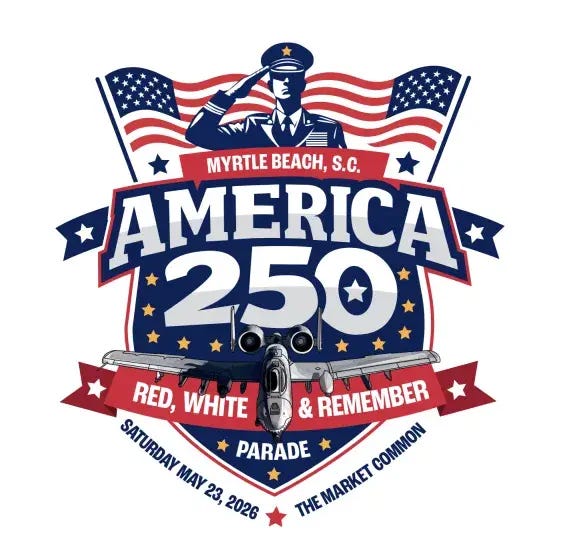
Grab your golf carts, friends, family and most importantly… your red, white and blue to celebrate America’s birthday and our country’s veterans! Perhaps the Grand Strand’s most patriotic event to honor America’s 250th birthday, the Red, White and Blue Parade, will take place Saturday, May 23 at Myrtle Beach’s Market Common at 10 a.m..
You can walk the parade or ride on your golf cart, in your vehicle or purchase an already decorated float for $850 (details in parade application). The parade route is around The Market Common, beginning at Johnson Avenue and Farrow Parkway, to be followed by a family picnic with kid-friendly activities and live music. More details to come on the picnic. Sign up for the parade today! For more information click http://www.visitmyrtlebeach.com/events/america-250-red-white-and-remember-parade.