
Friday, May 8
Connecting the Carolinas — Exploring Edenton and Chowan estuaries; Claremont: Justice Alito cleans up voting rights; South Carolina Governor's Cup; Georgetown Sporting Clays Shoot for GOP

Explore the estuaries of Edenton and Chowan counties

By CDD Staff
Adventures await those who have not been to some of Eastern North Carolina’s most remote and attractive estuaries. Paddle where some of the earliest settlers met the natural environment.
Edenton and Chowan counties of North Carolina have many paddling trails that help guide your way. Take your kayak or canoe on one of these trails, which range from beginner to advanced.
Click here to learn about your options for an exciting trip: https://visitedenton.com/explore-edenton/outdoor-recreation/. Scroll down to paddling trails and see what suits you.

Justice Alito cleans the Augean Stable of faux voting rights precedents
Callais restores the VRA to its original purpose.
By Mark Pulliam
The Supreme Court’s landmark decision in Louisiana v. Callais may dramatically alter congressional districts in Southern states. Writing for a 6-3 majority, Justice Samuel Alito unraveled decades of confusing and misguided caselaw construing the 1965 Voting Rights Act (VRA) to hold that states may not engage in racial gerrymandering — or be forced to do so by federal courts — when drawing congressional districts. The Constitution’s Equal Protection Clause forbids race-based discrimination, Alito pointedly declared, preventing Section 2 of the VRA from being interpreted to require the creation of “majority-black” districts to comply with the VRA.
Congress enacted the VRA in 1965 (pursuant to Section 2 of the 15th Amendment) to prohibit states from disenfranchising blacks through obstacles such as poll taxes, literacy tests, property qualifications, white primaries and grandfather clauses — not to create electoral parity, a long-standing position of Justice Clarence Thomas’s that he repeated in his concurring opinion in Callais. As Justice Alito wrote for the majority, the “Voting Rights Act does not guarantee equal outcomes.”
Contrary to the claims of partisan critics, the decision in Louisiana v. Callais does not “gut” or “hollow out” the VRA. Nor, contrary to Justice Elena Kagan’s hysterical dissent, does the majority in Callais “eviscerate” the VRA or render Section 2 “all but a dead letter.” Justice Alito’s meticulous majority opinion merely prevents the VRA from being abused to dictate “proportional representation” — that is, racial quotas — contrary to the express language of Section 2, which states that “nothing in this section establishes a right to have members of a protected class elected in numbers equal to their proportion in the population.”
One of the effects of the court’s ruling will be producing Republican gains in the midterms. Improperly drawn maps, such as the Bayou State’s, will necessarily be revised to comply with Justice Alito’s narrowing of the leading VRA precedent, Thornburg v. Gingles (1986), authored 40 years ago by the notorious liberal activist Justice William Brennan. In a familiar scenario, Louisiana had created a second majority-black congressional district at the direction of a federal court, which interpreted the VRA to require greater representation for black voters. (In 2020, blacks comprised 31 percent of the state’s population.)
Reviewing and distinguishing the dense thicket of prior VRA precedents, the majority in Callais concluded that the Louisiana congressional map violates Section 2 of the VRA. Reaching this conclusion required a lengthy discussion of, and update to, the Supreme Court’s 1986 Gingles decision that caused much of the mischief and confusion under the VRA.
Alito’s mastery of the court’s labyrinthine precedents under the VRA allowed him to bring along colleagues not inclined to overrule Gingles altogether, such as Chief Justice Roberts and Justice Brett Kavanaugh, who upheld the decision just three years ago in Allen v. Milligan (2023). Alito’s consensus-building prowess has made him a remarkably effective originalist/textualist reformer on the Supreme Court, as Mollie Hemingway explains in her recently published biography of the justice, aptly titled Alito: The Justice Who Reshaped the Supreme Court and Restored the Constitution.
Justice Alito’s majority opinion in Callais genteelly narrowed the holding of Gingles, which he contended “was decided at a time when this court often paid insufficient attention to the language of statutory provisions,” a problem evident in Justice Brennan’s opinion. Callais holds that mere disparate impact is not the type of harm that violates the VRA or the 15th Amendment.
In revisiting Gingles, the court considered the “important developments” that have occurred in the past 40 years: Jim Crow is long over; the racial gap in voter registration and turnout has largely disappeared; a robust two-party system has emerged in most states; and in recent years, the court has strictly limited the permissible use of racial distinctions. Accordingly, race-based redistricting is forbidden.
Louisiana v. Callais is consistent with the Roberts Court’s broader effort to restore the 14th Amendment’s command of color-blindness to the high court, an approach that rejects the execrable body of “living Constitution” jurisprudence that I previously described in The American Mind as “an incoherent mélange of liberal pablum, a doctrinal wasteland.” One of the major failings of the non-originalist approach to constitutional law that prevailed under the tutelage of John Roberts’s predecessors, Chief Justices Earl Warren and Warren Burger, was the absurd notion that federal civil rights laws, enacted to remedy intentional race discrimination, should be construed to create equality of results rather than equality of opportunity. In this understanding, quotas require discrimination.
Hence, in the decades prior to the Supreme Court’s 2023 decision in SFFA v. Harvard, racial preferences in higher education (that is, racial and ethnic quotas) were permitted to achieve “diversity” despite statutory bans on race discrimination. Similarly, in Griggs v. Duke Power Co. (1971), the court embraced the quota-conscious theory of “disparate impact” in employment discrimination, even though the relevant statute (Title VII of the Civil Rights Act of 1964) prohibits only “intentional” discrimination, stating that preferential treatment is not required to achieve statistical parity in the workforce. Callais merely aligns the VRA with the race-neutrality dictated by the Equal Protection Clause of the 14th Amendment.
Despite the relatively straightforward statutory language, the Supreme Court’s opinions interpreting the VRA had created a bewildering doctrinal morass, strongly suggesting that race-predominant districting was permitted — or even required — to provide adequate “opportunities” for protected minorities to elect representatives of their choice. Congressional districts are drawn by state legislatures through gerrymandering, a practice dating to the early 19th century, often for the partisan benefit of the political party that controls the legislature. Disputes concerning gerrymandering are considered non-justiciable — meaning that courts will decline to review them since they involve political matters.
As a result of the court’s muddled caselaw, liberal groups frequently filed lawsuits under Section 2 of the VRA — or threatened to do so, cowing legislators — to force states to adopt more majority-minority districts. Compounding the problem, amorphous judicial precedents made it difficult to distinguish between partisan gerrymandering (which is permitted) and maps that violate Section 2 of the VRA, particularly since blacks form a reliably Democratic voting bloc.
Many lower federal courts had construed the court’s VRA precedents to require proportional representation for blacks and other minorities despite the explicit language to the contrary in Section 2. This is what happened in Louisiana, producing marathon litigation that ended in last week’s decision.
Louisiana redrew its six congressional districts after the 2020 census to account for population shifts, initially retaining the single majority-black district in the existing map, which included much of New Orleans. VRA litigation predictably ensued, and in 2022, a federal court ordered the state to create a second majority-black district stretching some 250 miles from Shreveport to Baton Rouge. White residents objected to the unwieldy map that was created to comply with the court’s ruling. The objectors convinced a different federal court in Louisiana that the SB8 congressional map was racially gerrymandered and violated the Equal Protection Clause. In Callais, the Supreme Court agreed with that assessment.
Callais is a game-changer. States are no longer required to create election districts to achieve proportional representation — quotas, in effect. The VRA still protects voting rights, but curbs litigation abuses. In the words of Ed Blum, the champion of color-blindness who founded Students for Fair Admission, bogus VRA litigation pressured states “to sort citizens by race and draw majority-minority districts to hit demographic targets.” The court’s prior VRA caselaw was not faithful to the text of the statute or to the Equal Protection Clause. Callais corrected that, restoring the original purpose of Section 2 and moving the nation toward a race-neutral system of election law.
Though leftist pundits are denouncing the court’s ruling because much of the Democrats’ political power rests on racially gerrymandered maps that will be redrawn, the decision is a triumph of originalist/textualist analysis and equality before the law.
Mark Pulliam is a contributing editor at Law & Liberty who blogs at Misrule of Law.
This article originally appeared in the Claremont Institute’s The American Mind.
South Carolina Governor’s Cup Billfishing Series begins

By CDD Staff
The Seabreeze Marina is where you will find the sportfishing boats and anglers participating in the first tournament of the conservation-themed South Carolina Governor’s Cup. From May 6-9, competitors will be heading to the blue water for action and returning to the dock for celebrations of victory or a toast to a good day on the water with friends and family.
Angling sportsmanship is an art to those who know it when they see it, and the late Gov. Carroll Campbell was the primary visionary behind establishing a tournament that encouraged catch and release habits among anglers.
The next tournament will be the 58th Annual Georgetown Blue Marlin Tournament, which runs May 20-23.
The CDD wishes tight lines and safe travels to all competitors.


Saltwater fishing trends
Courtesy of SCDNR
North Grand Strand
Inshore: Captain Smiley Fishing Charters (843) 361-7445 reports that after a good late April they have high expectations for May, and redfish, trout and black drum should all continue to be caught in the creeks as well as at the jetties. Live shrimp will catch all three species. The flounder were already arriving by the end of April, and this month more bigger fish should return. They will take mud minnows.
Cherry Grove Pier (843) 249-1625 reports that that his month they should continue to catch Spanish mackerel, bluefish and abundant whiting, and the flounder should get bigger. However, the real excitement is that water temperatures are already where they need to be for king mackerel to start the month and at some point very soon numbers of kings should arrive.
Nearshore: Captain Smiley Fishing Charters reports that bluefish and Spanish mackerel fishing was strong by the end of April, and it should get even better this month. The tail end of the bonito fishing should last into early May while big weakfish should be around a bit longer. Cobia should arrive by about the third week of May.
Most detailed North Grand Strand Updates
South Grand Strand
Inshore: Captain Caleb Hartley (843) 241-7706 reports that typically the flounder fishing turns on earlier, but at the end of April the fish began to show up in impressive numbers. They will eat mud minnows, finger mullet, and more. May is usually not a great month for trout in Murrells Inlet, but redfish usually feed better this month. They will eat a variety of cut and live baits.
Nearshore: Captain Caleb Hartley reports that bluefish, Spanish mackerel, spadefish, and king mackerel should all bite well this month.
Most detailed Southern Grand Strand Updates
Georgetown
Inshore: Captain Greg Holmes (843) 241-0594 reports that by the end of April redfish were moving towards their warm weather patterns and feeding more consistently, and May should see even more improvement. With more bait around and fish broken out of winter schools they are more dispersed but often easier to locate since they are in more places, and in May fish will take a variety of baits including live finger mullet, cut mullet, mud minnows, and shrimp. Trout will also feed better this month, and in May big trout should be caught around the moon phases when they spawn in the rivers. Live shrimp are hard to beat but they will also take artificial baits like Vudu shrimp. Flounder will also get more prolific as they return inshore, and by the end of April some keepers had already arrived. The jetties should also be loaded with sheepshead, black drum and more.
Unlocking cultural treasure, Part XXXVII
Alphabet/Aleph Bet. אלף בת
By Susan Weintrob
The Hebrew alphabet evolved from its pictorial origins about 4,000 years ago. Each letter evolved from a picture of a specific word. The word alphabet evolved from first two letters of Hebrew, Aleph א and Bet ב .The word representing the letters of writing came to be called in English, the Alphabet.
The ancient Hebrew word for ox was Aleph. Its head and horn were drawn and became symbolized, then rotated. The second letter, Bet, was first a house, bayit.
The ancient Hebrew alphabet was adopted by the Greeks around the 12th century BCE. The first five letters of the Hebrew alphabet are aleph, beyt, gimel and dalet. These same letters, adopted by the Greeks, became the alpha, beta, gamma and delta.
The early ancient languages, such as Akkadian and Sumerian, were pictures that then became symbolic representation and then had sounds associated with each symbol, often from the first sound of the word/symbol. Egyptian hieroglyphics were also pictographs with associated sounds but never became a true alphabet.
The oldest biblical text we have in its entirety is the Book of Isaiah, housed in the Israel Museum’s the Shrine of the Book. It is dated to 200 BCE and is almost identical to modern version. The extant biblical texts use the modern square letters that can be read with a bit of effort by those who reads modern Hebrew.
Susan Weintrob, a retired academic, is a free-lance writer and food blogger living in South Carolina. Follow her blog at www.expandthetable.net.
Eight Oaks Park Fishing Rodeo — Georgetown County
By CDD Staff
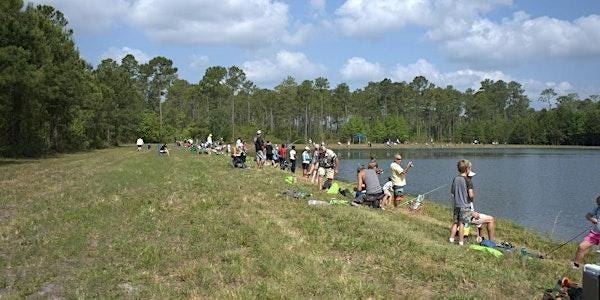
Spring is the time to get your line in the water, and young anglers in the Georgetown area will not want to miss the annual fishing rodeo this weekend at Eight Oaks Park this Saturday, May 9 from 8 to 11 a.m. It’s not hard to find Eight Oaks Park: the address is 6610 Highmarket St. in Georgetown, just three miles outside Georgetown on Highway 17. Bring the children and grandchildren and whet their fishing appetites. One lifetime license and other prizes will be given away.
For more information click, https://www.eventbrite.com/e/8-oaks-park-fishing-rodeo-georgetown-county-registration-1982894253089.
Sporting Clays Shoot in Celebration of the 250th Anniversary of America

By CDD Staff
Keen Carolina wing-shots who tilt right are invited to the May 21 Sporting Clays Shoot in Celebration of the 250th Anniversary of America. Get ready to break some targets and have a big time at the Sporting Clays Shoot hosted by the Georgetown County GOP at the Back Woods Quail Club.
Whether you’re a pro or trying out sporting clays for the first time, this event is all about good vibes and great shots. Don’t miss the chance to hang out, improve your aim and meet Republican candidates. Bring your A-game and make some memories at the sporting clays shoot.
Registration is from 10 a.m. to noon; lunch is 11 a.m. to noon; welcome and safety briefing is noon to 12:30; shoot runs 12:30-3:30 p.m.; and awards ceremony will take place from 3:30 to 4 p.m.
Get your tickets by clicking here: https://allevents.in/georgetown/sporting-clays-shoot-in-celebration-of-the-250th-anniversary-of-america/100001985455935149#google_vignette
Back Woods Quail Club is located at 647 Hemingway Ln. in Georgetown.